
Choosing a platform for your online store is one of the few decisions in e-commerce that is practically irreversible in the short term. Migrating from one system to another means months of development work, a risk of losing search rankings and significant costs. Made hastily or on someone else's recommendation, this decision can constrain your business growth for years.
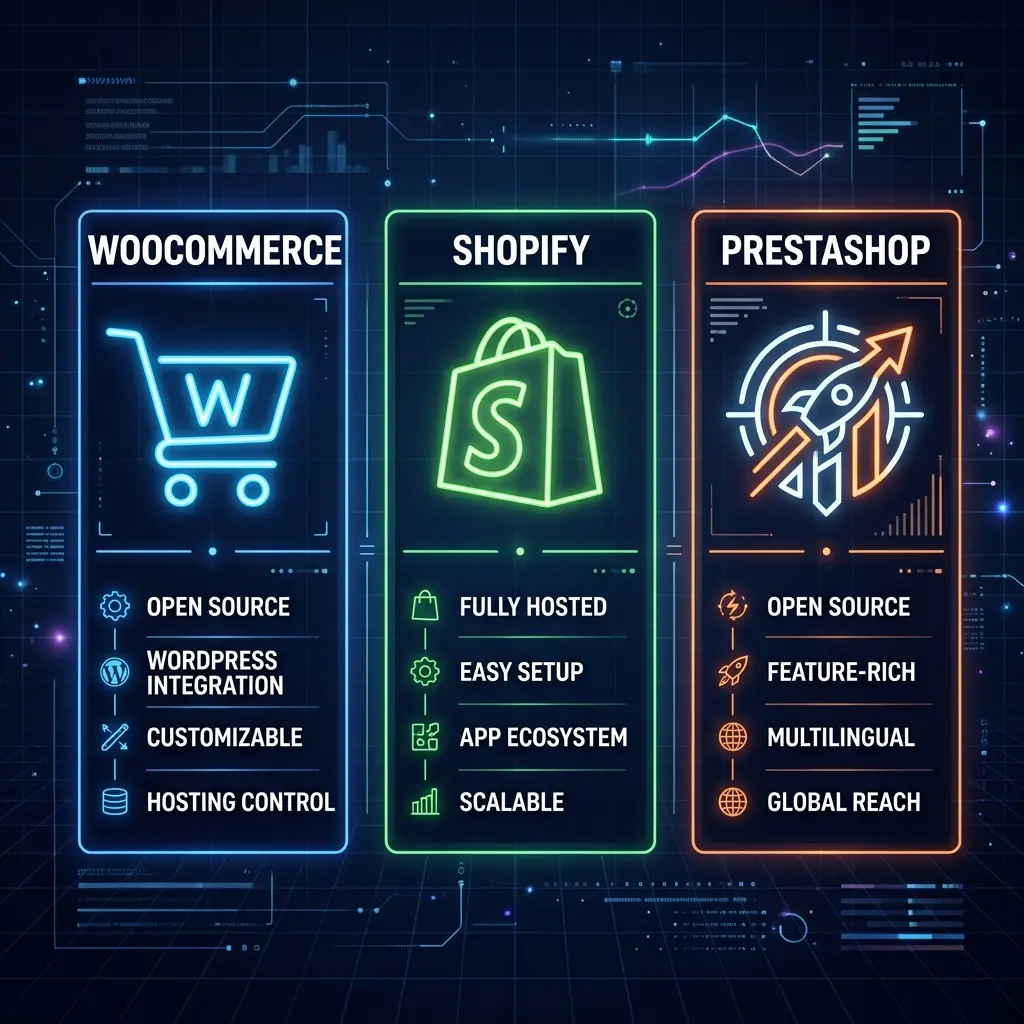
The e-commerce market has many established platforms — from OpenCart and Magento to WooCommerce and Shopify. Each has its audience. Our work is entirely with PrestaShop, and in this article we will explain honestly why we consider it the right choice for mid-size and larger e-commerce businesses — and what awaits you with the alternatives before you reach the same conclusion through costly experience.
WooCommerce: A Free Start With an Expensive Continuation
WooCommerce started as a WordPress plugin, and that is simultaneously its strength and its limitation. The low barrier to entry attracts hundreds of new stores every day. The problems come later.
The Architecture Works Against You at Scale
WordPress was not designed as an e-commerce platform. Added on top, WooCommerce carries all the structural compromises of that architecture. With stores exceeding 1,000–2,000 products and real traffic, the system begins to demand serious infrastructure and ongoing optimisation just to remain functional — not to be fast, simply to work.
"Free" Is Only the Beginning
WooCommerce itself is free. But a real store has needs: advanced product variations, subscription payments, loyalty programmes, advanced reports, B2B functionality. Each of these is a separate paid plugin with an annual licence. The real cost of plugins for an average store routinely exceeds 500–1,000 EUR per year — and unlike PrestaShop modules, these licences must be renewed to receive updates and support.
Security Requires Constant Attention
WordPress is the most attacked CMS platform in the world, a direct consequence of its popularity. Core, theme, dozens of plugins — everything must be updated in a coordinated manner, as incompatibilities between versions are frequent and real. One unpatched plugin is a potential entry point.
When WooCommerce Makes Sense
Honestly — for a small start with a limited budget and a catalogue of a few hundred products, WooCommerce can be a sensible starting point. The problem is that many businesses outgrow it and then migrate to PrestaShop, with all the costs and risks a migration entails. If you know you will grow, it is more sensible to build on the right foundation from the start.
Shopify: Paying Rent on Your Own Store
Shopify is built around one promise: simplify everything. You do not deal with hosting, security or updates. The platform handles those concerns in exchange for a monthly fee. And a percentage of every sale you make.
The Monthly Subscription Grows With Your Needs
Core plans range from 29 EUR (Basic) to 299 EUR (Advanced) per month. In practice, a store with real reporting and functional needs runs on the Shopify plan (79 EUR/month) or Advanced. Over three years, the subscription alone comes to between 2,844 and 10,764 EUR — money paid not for development or infrastructure, but for the right to use the platform.
Transaction Fees Are the Hidden Cost
Shopify charges an additional fee on every sale if you do not use Shopify Payments. In Bulgaria this option is not yet available, meaning every store in the country falls into this category: 2% on Basic, 1% on the Shopify plan, 0.5% on Advanced.
At an order volume of 15,000 EUR per month, the fee is 75–300 EUR monthly. At 50,000 EUR, it is 250–1,000 EUR per month, every month, on top of the subscription. Over three years at an average volume of 25,000 EUR per month, transaction fees alone exceed 4,500 EUR. PrestaShop charges nothing.
The Code Is Not Yours
Shopify works with the Liquid templating language in a closed environment. You have no access to the server-side logic. Custom functionality beyond what is anticipated requires expensive workarounds through applications or is simply impossible.
Custom pricing logic, non-standard courier integrations, a personalised checkout flow, bespoke B2B rules — everything that makes your business different from others is difficult or impossible to achieve.
The Dependency Is Permanent
Your data lives on Shopify's infrastructure. Migrating to another platform is a complex process. Terms and prices can change at any time and you have no alternative other than to comply or go through a painful migration.
PrestaShop: The Platform You Own
PrestaShop is an open-source platform designed specifically for e-commerce from the ground up. It is not a CMS with a shopping cart bolted on. It is not a SaaS with a monthly subscription. The code is entirely and permanently yours.
On the Bulgarian market OpenCart and Magento are equally established. OpenCart is favoured by many local developers for its simplicity. Magento (Adobe Commerce) is the de facto standard for large businesses with complex requirements. PrestaShop sits between them — more scalable and specialised than OpenCart, more accessible and manageable than Magento. It is not necessarily a "better" platform in absolute terms, but for the specific profile of a mid-size e-commerce business it offers a well-balanced combination of functionality, cost and technical freedom.
Zero Licence Cost, Zero Transaction Fees
The platform is free. You pay for hosting, development and modules — but not for the right to sell online. There are no transaction fees payable to the platform. At a turnover of 50,000 EUR per month, Shopify would take between 250 and 1,000 EUR just for the right to process your sales. With PrestaShop that amount stays in your business.
Full Code Freedom
With access to the entire source code, customisation has no practical limits. Non-standard business rules, integrations with local courier companies, specific pricing logic, personalised reports — all achievable without workarounds.
PrestaShop has a well-defined system of hooks, override classes and a modular architecture that allows functionality to be extended without modifying the core. Updates to the platform do not destroy customisations — a meaningful contrast to platforms where every personalisation is a battle against constraints.
Scalability
PrestaShop manages stores with tens of thousands of products and intensive traffic without structural limitations. Performance depends on infrastructure and development quality, not on artificial platform limits.
The Multistore feature enables management of multiple stores — different languages, currencies, domains — from a single admin panel. For businesses operating across more than one market, this is a significant advantage.
When PrestaShop Is Not the Right Choice
If you are starting with 20 products, a limited budget and need a store live by tomorrow — WooCommerce or OpenCart are a more pragmatic start. PrestaShop requires a quality initial setup and a developer who understands the platform. If your needs are truly enterprise-grade — complex B2B logic, deep ERP integration, thousands of concurrent users — Magento is the platform designed for that complexity.
Suited to: stores with more than 500 products, businesses needing custom logic, companies planning growth and market expansion, and anyone who does not want to pay a monthly rental fee for the right to sell online.
Comparison Table
| WooCommerce | Shopify | PrestaShop | |
|---|---|---|---|
| Licence cost | Free | 29–299 EUR/month | Free |
| Transaction fees | None | 0.5–2% (in Bulgaria) | None |
| Source code access | Partial (WordPress) | None | Full |
| Scalability | Medium | High (infrastructure) | High |
| Customisation | Medium | Low | Full |
| Multistore | Via additional plugin | Via additional plan | Built-in |
| Vendor lock-in | Low | High | Low |
| Local BG integrations | Via paid plugins | Limited | Widely supported |
| Suitable catalogue size | Up to ~1,000 products | Unlimited | Unlimited |
| Recurring costs | Plugins | Subscription + fees | Hosting only |
Indicative Three-Year Cost
For a store with a turnover of ~15,000 EUR/month over a three-year period:
| WooCommerce | Shopify (Advanced) | PrestaShop | |
|---|---|---|---|
| Platform (36 months) | 0 EUR | 10,764 EUR | 0 EUR |
| Transaction fees (0.5%) | 0 EUR | 2,700 EUR | 0 EUR |
| Hosting (36 months) | ~900 EUR | Included | ~1,300 EUR |
| Plugins / modules | ~1,500 EUR | ~5,400 EUR | ~1,200 EUR |
| Indicative total | ~2,400 EUR | ~18,864 EUR | ~2,500 EUR |
WooCommerce and PrestaShop come out financially comparable over three years. The difference lies in what you get: WooCommerce is a WordPress plugin with inherent scaling constraints; PrestaShop is a dedicated e-commerce platform designed to grow with your business.
Conclusion
There is no universal answer, but there is logic to the choice depending on the stage of your business.
If you are starting small with a limited budget and catalogue — WooCommerce is a reasonable starting point. The problem is that many businesses outgrow it and migrate to PrestaShop — with all the costs that entails. If you know you will grow, build on the right foundation from the start.
If simplicity is the priority and you are willing to pay for it — Shopify does the job, provided you are clear on the real monthly cost at any non-trivial turnover and on the constraints around customisation.
If you are building a business with a long-term perspective, a need for customisation and no desire to pay a monthly rental fee for the right to sell online — PrestaShop is the mature solution in exactly the right position between accessible OpenCart and heavyweight Magento.
If you are unsure which platform to start with, or want to assess whether your current store is built on the right foundation, contact us for a free consultation.
Sources
- Shopify — Pricing plans, official page, 2026
- Shopify Help Center — Transaction fees, 2026
- PrestaShop — Open source e-commerce solution, official site
- WooCommerce — Extensions Store, official extensions store
- Builtwith.com — E-commerce usage statistics, platform market share, 2026
- Sucuri — Website Hacked Trend Report, annual CMS security report
- PrestaShop Developer Documentation — Multistore, version 8.x