
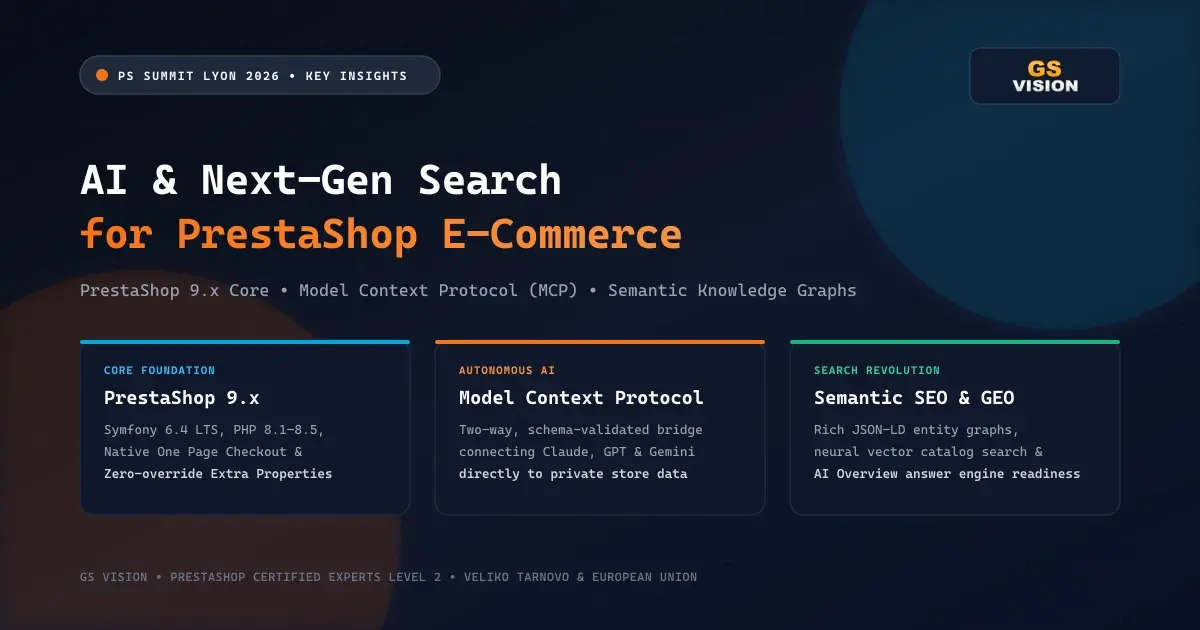
On 4 and 5 November 2026, the European open-source e-commerce community gathered at the Centre des Congrès de Lyon for PS Summit 2026, co-organized by PrestaShop and Sylius. Bringing together over 500 core maintainers, enterprise merchants, and specialized agencies from across France, Germany, Italy, Spain, and Eastern Europe, the event served as a definitive barometer for the trajectory of open-source commerce.
For the GS VISION engineering team, attending the summit's technical workshops and core contributor sessions confirmed a fundamental thesis we have championed throughout the past year: the era of routine e-commerce shopkeeping has ended.
The industry conversation has decisively moved past superficial front-end polish, basic module installation, and reactive maintenance. Today, high-growth European brands face a dual technical frontier: the transition to autonomous AI-driven operations via standardized protocols like MCP, and the radical transformation of organic discovery from traditional 10 blue links to Generative Engine Optimization (GEO) and conversational answer engines.
Below is our architectural synthesis of what transpired in Lyon, why these developments matter for your store, and how forward-thinking merchants can capitalize on them.
1. The Lyon Pulse: E-Commerce Beyond Traditional Boundaries
Walking through the amphitheaters and workshop stages at the Centre des Congrès de Lyon, one sentiment resonated universally among technical directors and platform architects: e-commerce software must evolve from a passive database with a web skin into an active, intelligent operational hub.
For years, the open-source e-commerce paradigm was predictable:
- Render HTML templates via server-side scripting.
- Query relational databases with standard SQL indices.
- Optimize keywords for Google’s web crawler.
- Manage daily order workflows through static, table-heavy back-office interfaces.
In Lyon, that paradigm was officially declared obsolete. With the maturity of PrestaShop 9.2—built upon a modernized Symfony LTS foundation—the open-source core has decoupled business logic from display mechanics.
Concurrently, the emergence of autonomous LLM agents (powered by Google Gemini, Anthropic Claude, and OpenAI) and conversational search engines (Google AI Overviews, ChatGPT Search, Perplexity) has created an entirely new interface between merchants, algorithms, and consumers.
Instead of debating cosmetic checkout tweaks, discussions at the summit centered around three high-impact pillars:
- Machine-to-Store Interoperability: Enabling private AI assistants to securely inspect, analyze, and act upon live store data using the Model Context Protocol (MCP).
- Semantic Product Knowledge Graphs: Structuring catalog data so dense and unambiguous that answer engines can synthesize and recommend products in real-time zero-click searches.
- Neural Vector Discovery: Replacing brittle SQL
LIKEsearch modules with embedding-based semantic search engines that match shopper intent rather than literal character strings.
2. Why Traditional E-Commerce SEO Is No Longer Enough
For two decades, e-commerce search engine optimization followed a familiar playbook: target high-volume search queries, insert keywords into <title> tags and <h1> headings, build category backlinks, and optimize for Google’s ten blue links.
At PS Summit Lyon 2026, technical SEO roundtables delivered a blunt reality check: traditional keyword ranking is rapidly losing its monopoly over commercial traffic.
Traditional Search (Past 20 Years):
User Query ──▶ Keyword Matching ──▶ 10 Blue SERP Links ──▶ Storefront Click

Generative Engine Search (Present & Future):
User Natural Prompt ──▶ Entity Resolution & Knowledge Graph Extraction ──▶ Multi-source Synthesis (AI Overview) ──▶ Direct Conversational Recommendation
The Shift from Blue Links to Answer Engines (GEO)
Consumers no longer search solely with isolated keywords like "waterproof hiking boots men". Increasingly, they prompt conversational engines with contextual, multi-criteria problems:
"I am doing a 4-day hike in the Swiss Alps in late November with expected sub-zero temperatures and wet rocky trails. Compare durable waterproof boots under €220 with vibram soles and good ankle stability that can be delivered to Munich by Thursday."
A traditional keyword index cannot parse that intent. Instead, conversational search systems:
- Dissect the multi-dimensional query into discrete functional requirements (temperature rating, waterproof membrane, sole compound, geo-delivery constraint, price cap).
- Scan structured product knowledge graphs across indexed domains rather than parsing unformatted HTML text.
- Synthesize a unified answer panel (Google AI Overview, Perplexity answer box, or ChatGPT Search citation) that presents specific SKUs directly inside the answer, linking only to authoritative, verifiable sources.
This discipline is known as Generative Engine Optimization (GEO). In GEO, your store does not compete merely to be "ranked #1"; it competes to be the verified entity that the LLM selects as the source of truth.
Semantic Entities Over Keywords: Dense JSON-LD Graphs
To be legible to an answer engine, your catalog must be expressed as a connected semantic graph. In Lyon, significant focus was placed on PrestaShop 9.2's upgraded core capabilities for rendering clean, server-side JSON-LD structured data.
Rather than scattering fragmented microdata across Smarty or Twig template files—which frequently break during theme updates—modern PrestaShop architectures leverage Symfony hooks (actionFrontControllerSetVariables) to emit comprehensive, schema-validated entity graphs directly in the document <head>:
{
  "@context": "https://schema.org",
  "@graph": [
    {
      "@type": "Product",
      "@id": "https://example.eu/boots/alp-pro-gtx#product",
      "name": "Alp Pro GTX Waterproof Mountain Boots",
      "sku": "ALP-GTX-43",
      "gtin13": "3800123456789",
      "brand": {
        "@type": "Brand",
        "name": "Nordic Peak"
      },
      "description": "High-altitude waterproof trekking boot with Gore-Tex membrane and Vibram Arctic Grip sole.",
      "category": "Footwear > Mountain Boots",
      "offers": {
        "@type": "Offer",
        "@id": "https://example.eu/boots/alp-pro-gtx#offer",
        "price": "199.00",
        "priceCurrency": "EUR",
        "availability": "https://schema.org/InStock",
        "itemCondition": "https://schema.org/NewCondition",
        "url": "https://example.eu/en/boots/alp-pro-gtx.html",
        "hasMerchantReturnPolicy": {
          "@type": "MerchantReturnPolicy",
          "applicableCountry": "DE",
          "returnPolicyCategory": "https://schema.org/MerchantReturnFiniteReturnWindow",
          "merchantReturnDays": 30,
          "returnMethod": "https://schema.org/ReturnByMail",
          "returnFees": "https://schema.org/FreeReturn"
        },
        "shippingDetails": {
          "@type": "OfferShippingDetails",
          "shippingRate": {
            "@type": "MonetaryAmount",
            "value": "0.00",
            "currency": "EUR"
          },
          "deliveryTime": {
            "@type": "ShippingDeliveryTime",
            "handlingTime": { "@type": "QuantitativeValue", "minValue": 0, "maxValue": 1, "unitCode": "DAY" },
            "transitTime": { "@type": "QuantitativeValue", "minValue": 1, "maxValue": 2, "unitCode": "DAY" }
          }
        }
      }
    }
  ]
}
Notice the semantic granularity: explicit delivery windows, return policies, GTIN identification, and country-specific offer scopes. When an answer engine computes a response for a European shopper, stores providing this level of unambiguous machine data are prioritized, while stores relying on plain HTML descriptions are bypassed.
Sub-Second Core Web Vitals as an AI Crawling Prerequisite
A critical insight highlighted during the technical infrastructure talks: AI crawlers operate under strict execution budgets.
When an LLM agent or real-time search engine fetches product data to synthesize an answer, its retrieval window is measured in milliseconds. If your store suffers from high Time to First Byte (TTFB > 800 ms) due to legacy database bottlenecks, or triggers violent layout shifts (CLS > 0.1) that disrupt headless DOM parsing, the agent aborts retrieval and cites a faster competitor.
Fast Core Web Vitals are no longer just a human usability metric—they are the prerequisite for inclusion in modern AI retrieval loops.
3. Bringing Model Context Protocol (MCP) & LLMs to PrestaShop
The technical highlight of PS Summit Lyon 2026 was without question the expansion of the Model Context Protocol (MCP) across the PrestaShop ecosystem.
Originally authored by Anthropic and rapidly adopted as an open industry standard by Google, Microsoft, and leading developer platforms, MCP solves a historical challenge: how can external AI systems safely interact with private corporate databases without building custom, fragile API integrations for every model?
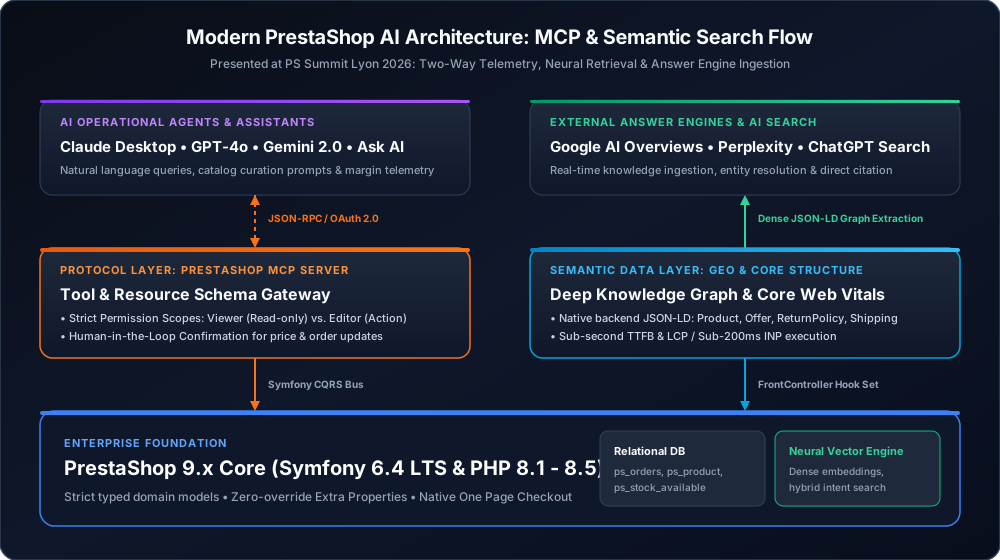
What MCP Means for E-Commerce Architecture
Historically, connecting an LLM to a store required one of two flawed approaches:
- Dumping store exports into third-party AI SaaS tools, creating severe data privacy risks and synchronization delays.
- Exposing generic REST APIs to an LLM, which inundates the model's context window with massive, unstructured JSON payloads, drives up token costs, and risks unintended data modifications.
MCP introduces an open, two-way protocol based on JSON-RPC 2.0. Instead of dumping raw database dumps, the PrestaShop MCP Server exposes three strictly defined constructs to the connected AI client:
- Tools: Callable functions with rigorous schema contracts (e.g.,
get_stock_anomalies(category_id, threshold),update_product_price(product_id, new_price)). - Resources: Real-time data streams and documents (e.g., live orders stream, European VAT rate table).
- Prompts: Pre-engineered operational workflows that guide the AI through structured administrative routines.
Crucially, MCP operates under strict security boundaries:
- OAuth 2.0 Token Scoping: Access is granted per session with strict role separation (such as
Viewerfor analytical read-only tasks vs.Editorfor operational tasks). - Human-in-the-Loop Safeguards: Destructive operations (price alterations, status updates, stock deductions) require explicit merchant confirmation before database execution, preventing rogue hallucination errors.
Real-World Architectures GS VISION Builds with MCP
At GS VISION, we have spent months translating the MCP standard into production-grade systems for European merchants. In Lyon, our conversations with ecosystem peers reinforced three primary use cases where MCP delivers immediate, compounding ROI:
1. Conversational Business Intelligence & Operational Telemetry
Traditional e-commerce analytics force business managers to navigate dozens of back-office tabs, configure SQL queries, or export cumbersome CSV files.
With an MCP-connected back-office assistant (such as Ask AI in PrestaShop 9.2 or an internal Claude/GPT workspace), store managers can execute complex telemetry queries using natural language:
- "Identify the top 10 products with high cart-abandonment rates in the German market over the past 14 days, and correlate them with our shipping cost updates."
- "Which suppliers have delivered orders with more than 5% damaged-item reports this quarter?"
- "Show me all B2B customer accounts with zero orders in the last 60 days whose average historical basket exceeded €1,500."
The AI queries the PrestaShop relational schema (ps_orders, ps_order_detail, ps_cart, ps_customer), joins the relevant data points, and outputs an actionable diagnostic summary in seconds—without requiring a developer to build a dedicated dashboard.
2. Automated Semantic Catalog Curation
Catalog enrichment is one of the heaviest operational overheads for growing stores. Merchants receiving supplier feeds with thousands of poorly formatted SKUs typically struggle with missing attributes, vague titles, and absent search metadata.
Through custom MCP tools built by GS VISION, an AI agent can:
- Inspect raw supplier feeds and automatically extract standardized technical specifications (dimensions, materials, compatibility, certifications).
- Assign them cleanly to native PrestaShop Features and Extra Properties without manual entry.
- Generate culturally and idiomatically accurate product copy localized for cross-border European markets (English, German, French, Italian, Bulgarian), strictly abiding by tone and length parameters.
- Populate structured SEO schemas and meta attributes matching target search entity graphs.
3. Vector/Embedding Search (Neural Search)
Standard PrestaShop search operates on keyword indexing and SQL string matching (LIKE %term%). If a shopper misspells a word, uses a regional synonym, or describes an abstract problem rather than a product code, the store returns the dreaded: "No products found".
In Lyon, high-performance search workshops demonstrated how neural vector search eliminates this friction:
Customer Prompt: "Comfortable ergonomic chair for 10-hour desk shifts with breathable mesh back"
                               │
                               ▼
     Text Embedding Model (e.g., text-embedding-3 / open-weights)
                               │
                               ▼
           High-Dimensional Vector: [0.021, -0.045, 0.189, ...]
                               │
                               ▼
        Vector Database Search (Cosine Similarity Ranking)
                               │
                               ▼
   Matches "ErgoPro Task Chair" (even though the word "shifts" never appears in title!)
By storing dense vector embeddings of product titles, descriptions, and extra attributes in a vector-capable index (such as pgvector or Meilisearch), the search engine matches conceptual semantic intent rather than literal characters. The result is a dramatic increase in conversion rates on high-intent internal search traffic.
⚡ GS Vision AI Embedder in Production: While many in the ecosystem are still discussing proof-of-concept scripts, GS VISION has already engineered and actively deployed our dedicated neural infrastructure — GS Vision AI Embedder. Operating silently across enterprise production catalogs, our high-throughput pipeline vectorizes catalog inventories in real time and feeds dense semantic embeddings directly into merchant storefronts. Early-adopter merchants running this architecture have already eliminated "zero results found" queries and unlocked double-digit conversion gains.
4. Safe Evolution: PrestaShop 9.x as the Modern Foundation
Deploying cutting-edge AI pipelines and semantic search architectures requires a clean, robust technical foundation. One of the strongest takeaways from the technical sessions in Lyon was the danger of compounding architectural technical debt.
The Technical Debt Trap
Across Europe, thousands of merchants operate on legacy PrestaShop 1.7 or early 8.x installations burdened by:
- End-of-life PHP versions (PHP 7.4 / 8.0) that lack modern JIT acceleration and expose critical security vulnerabilities.
- Unmaintained third-party modules that overwrite core PHP classes via fragile files in the
/override/directory. - Bloated relational tables with fragmented indices, producing server response times (TTFB) in excess of 1.5 seconds.
- Cluttered JavaScript bundles that block the browser thread, destroying Interaction to Next Paint (INP) scores.
Attempting to mount modern AI agents, WebMCP tools, or real-time vector search on top of an unstable legacy foundation is a recipe for catastrophic failures, data corruption, and search penalties.
Why PrestaShop 9.x Is the Prerequisite for AI Integration
PrestaShop 9.x represents a watershed moment for the platform's engineering integrity:
- Full Symfony 6.4 LTS Core: Provides a strictly typed, modular enterprise framework that replaces procedural legacy code.
- PHP 8.1 to 8.5 Support: Delivers massive memory optimization and near-instant script execution times.
- Native One Page Checkout (
ps_onepagecheckout): Eliminates the single largest source of third-party module conflicts in PrestaShop history. - Extra Properties System: Allows developers to register custom fields on core entities (
Product,Customer,Order) natively, cleanly removing the need for database table hacks or class overrides. - Decoupled API Architecture: Provides clean REST and GraphQL extension points that allow MCP servers and external services to communicate with zero overhead.
Before investing in advanced AI automation, forward-thinking merchants must execute a disciplined, zero-loss migration to PrestaShop 9.x.
5. The GS VISION Perspective & Next Steps
As an official PrestaShop Certified Expert Level 2 agency with over 15 years of continuous engineering experience and more than 500 successful e-commerce projects delivered across Bulgaria and the European Union, GS VISION approaches these technological shifts with engineering discipline.
We do not chase speculative AI novelties or promote fragile plugins. We evaluate technology through a singular lens: does this architecture deliver measurable operational efficiency, higher conversion velocity, and sustainable competitive advantage for our clients?
The insights gained from PS Summit Lyon 2026 reaffirm our strategic roadmap for enterprise merchants:
- Audit & Architecture Sanitation: Eliminate legacy core overrides, retire redundant third-party modules, and establish clean staging environments.
- Zero-Loss PrestaShop 9.x Migration: Migrate core databases, customer records, and order histories to the modern Symfony-powered engine with zero downtime.
- Semantic GEO & JSON-LD Graph Deployment: Upgrade front-end and core rendering to provide dense, authoritative structured data for Google AI Overviews and answer engines.
- MCP & Neural Search Integration: Implement secure PrestaShop MCP servers for back-office intelligence and vector search pipelines that turn browsing intent into sales.
Ready to Future-Proof Your E-Commerce Architecture?
Whether you need to migrate an established store to PrestaShop 9.x, implement Model Context Protocol (MCP) workflows, or optimize your catalog for AI search visibility, our team of certified PrestaShop engineers is ready to assist.
Schedule a Technical Consultation with GS VISION to review your store’s architecture, performance metrics, and AI readiness.
Frequently Asked Questions
What is Generative Engine Optimization (GEO) and how does it differ from traditional SEO?
Traditional SEO optimizes for keyword rankings within Google's classic list of ten blue links. Generative Engine Optimization (GEO) focuses on structuring your website's data, entity relationships, and technical authority so that conversational answer engines—such as Google AI Overviews, Perplexity, and ChatGPT Search—can understand, synthesize, and cite your products directly within generative answer panels.
Can I implement Model Context Protocol (MCP) on PrestaShop 8, or is PrestaShop 9 required?
The official PrestaShop MCP module supports versions starting from PrestaShop 8.2+ up through PrestaShop 9.x, requiring PHP 8.1 or higher. However, PrestaShop 9.x offers significant architectural advantages—including the new Extra Properties framework and a fully modernized Symfony 6.4 core—making it the recommended long-term platform for production AI deployments.
Does vector neural search completely replace the default PrestaShop search?
In enterprise implementations, vector search typically functions as a hybrid engine. It combines traditional lexical search (for exact SKU, part numbers, and brand lookups) with high-dimensional vector embeddings (for semantic problem-solving, natural language queries, and synonyms). This hybrid approach ensures that shoppers find exact technical products as well as broadly descriptive items.
How does MCP protect sensitive customer data and store privacy?
Unlike third-party chatbots that require exporting your database to external servers, MCP operates as an on-premise protocol. Communication occurs through authenticated JSON-RPC requests governed by OAuth 2.0. Merchants define granular permission roles (such as read-only Viewer access) and mandate explicit human confirmation before any write or update command can execute.
What is the recommended timeline for upgrading to PrestaShop 9.x?
For a mid-to-large e-commerce store with 30+ modules, custom ERP integrations, and custom templates, a professional migration typically spans 2 to 4 weeks. This includes an initial architectural audit, migration to a staging server, module compatibility testing, checkout and payment verification, and a coordinated zero-downtime go-live.
Sources & References
- PrestaShop Official Project — PrestaShop 9.2 Release & Core Architecture
- PS Summit 2026 Lyon — Official Event & Conference Agenda
- PrestaShop Developer Documentation — PrestaShop MCP Server Specifications
- Anthropic — Model Context Protocol (MCP) Open Specification
- Google Search Central — Structured Data Guidelines & Merchant Listings
- W3C Web Machine Learning Community Group — WebMCP Working Draft
- GS VISION Knowledge Base — PrestaShop MCP: Complete Guide to AI Store Management
- GS VISION Technical Guide — Upgrading to PrestaShop 9.2: Step-by-Step Migration